flowchart TD

EE[Estrategias \nde enseñanza].->UL(Uso de \nlenguaje\nneutral).->E(Estereotipos)-->AN(Ansiedad)-->ES(Esfuerzo)

ES-->R
AN-->A(Autoconfianza \nniñas)-->R(Resultados STEM)
style EE fill:#e2e9d2
style R fill:#d9d2e9
Resumen
En el caso del rendimiento en matemáticas, donde las mujeres son consideradas estereotipadamente inferiores a los hombres, hacer que el género sea más destacado en un entorno relacionado con las matemáticas puede afectar negativamente el rendimiento de las mujeres. Este efecto puede ocurrir debido a un aumento de la ansiedad y la carga cognitiva o una disminución del esfuerzo y la atención. Los hallazgos del estudio respaldan el mecanismo de amenaza de los estereotipos, ya que las mujeres obtienen mejores resultados en las preguntas de matemáticas cuando se abordan de una manera que no activa los estereotipos de género. Sin embargo, no se observa ninguna mejora significativa en el desempeño de las preguntas verbales.
El artículo encuentra que el cambio a un lenguaje más neutral en cuanto al género se asocia con una mejora significativa en el desempeño de las mujeres en preguntas cuantitativas, lo que reduce significativamente la brecha de género entre el desempeño masculino y femenino en estas preguntas.
Resumen visual
Parsing text into sentences and tokens...DONE
Calculating pairwise sentence similarities...DONE
Applying LexRank...DONE
Formatting Output...DONE
[1] "We find that the change to a more gender-neutral language was associated with a significant improvement in the performance of women on quantitative questions, which meaningfully reduced the gender gap between male and female performance on these questions."
[2] "As before, columns (5) and (6) provide the results for the specification that includes the gender ambiguous questions separately for women and men test takers."
[3] "The section fixed effect captures differences between the various sections, while the test takers’ fixed effect captures any difference between the different test takers and enable us to conduct within test- taker analysis, estimating the relative improvement of test takers in questions in which the form of address was gendered compared to questions which have no reference to gender."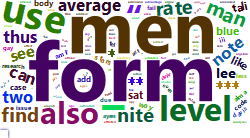
Referencias
Referencias citadas por el artículo de Cohen et al. (2023)
Ayres, Ian, Tamar Kricheli‐Katz, and Tali Regev (2023), “Do Languages Generate Future Oriented Economic Behavior?.” Proceedings of the National Academy of Science.
Bracha Anat, Alma Cohen and Lynn Conell-Price (2013), “The Heterogeneous Effect of Affirmative Action on Performance,” Journal of Economics Behavior and Organization, Vol. 158, pp. 172-218
Everett, Caleb. (2013) “Linguistic relativity.” In Linguistic Relativity. De Gruyter Mouton.
Levinson, Stephen C. (2012) Foreword. In Language, Thought, and Reality: Selected Writings of Benjamin Lee Whorf, ed. JB Carroll, SC Levinson, P Lee, pp. vii–xxiii. Cambridge, MA: MIT Press. 2nd ed.
Spencer, S. J., Steele, C. M. & Quinn, D. M. (1999), “Stereotype threat and women’s math performance,” J. Exp. Soc. Psychol, Vol. 35, pp. 4–28
Steele, C. M. & Aronson, J. (1995), “Stereotype threat and the intellectual test performance of African Americans,” J. Pers. Soc. Psychol., Vol. 69, pp. 797–811
Whorf, Benjamin. Carroll, John B. (ed.) (1956), Language, Thought, and Reality: Selected Writings of Benjamin Lee Whorf, MIT Press.
Reutilización
Cómo citar
BibTeX
@online{robano2024,
  author = {Robano, Virginia},
  title = {Resumen del artículo de Cohen et al. (2023)},
  date = {2024-03-21},
  url = {https://ceibal-fichas-genero-stem.netlify.app/posts/lenguaje neutral/},
  langid = {es}
}
Por favor, cita este trabajo como:
Robano, Virginia. 2024. “Resumen del artículo de Cohen et al.
(2023).” March 21, 2024. https://ceibal-fichas-genero-stem.netlify.app/posts/lenguaje
neutral/.